Unique Features of SSM®
1. Built on four leading psychological theories
Evidence-based framework
- Carl Jung - Cognitive Types (1921): How we perceive and judge information — intuition, thinking, feeling, and sensing. SSM adapts Jung’s cognitive types into the construct of Cognitive Preferences.
- William James - Stream of Consciousness (1890): How selective attention across past reflection, present engagement, and future anticipation dynamically influences decisions. SSM extends this idea by framing these dynamic attentional patterns as Temporal Preferences.
- Christopher Peterson & Martin Seligman - VIA-IS (Values in Action Inventory of Strengths) (2004): Identifies 24 core character strengths grounded in positive psychology. SSM extends this strengths-based approach through a distinct set of 12 character strengths that partially overlap with VIA-IS.
- Walter Mischel & Yuichi Shoda - CAPS (Cognitive-Affective Personality System) (1995): Shows how behaviour varies by situation, but forms stable “if–then” personality patterns over time. SSM operationalises this situational perspective through an algorithm that produces a ranked profile of 12 participant strengths (1–12).
2. SSM matrix of 12 strengths
Visualise your profile
- SSM maps four Cognitive Preferences—sensing, feeling, thinking, intuition—across three Temporal Preferences: past reflection, present engagement, and future anticipation.
- These combine into 12 cognitive-affective units which, when aggregated across multiple situations, define each individual's ranked profile of 12 Character Strengths.
- The SSM Matrix—the theoretical structure underlying all individual assessments—is outlined below.
| Shaw Strengths Matrix® | ||||
|---|---|---|---|---|
| Character Strengths | Temporal Preferences | |||
| Past Reflection | Present Engagement | Future Anticipation | ||
| Cognitive Preferences | Intuition | Foresight | Confidence | Courage |
| Thinking | Curiosity | Objectivity | Fairness | |
| Feeling | Empathy | Tenacity | Prudence | |
| Sensing | Discernment | Practicality | Discipline | |
3. Fair and balanced survey design
Every strength counts
- Each strength is tested once against every other strength, resulting in 66 total questions.
- This ensures an accurate, unbiased assessment.
4. Smart strength ranking algorithm
Clarity of results
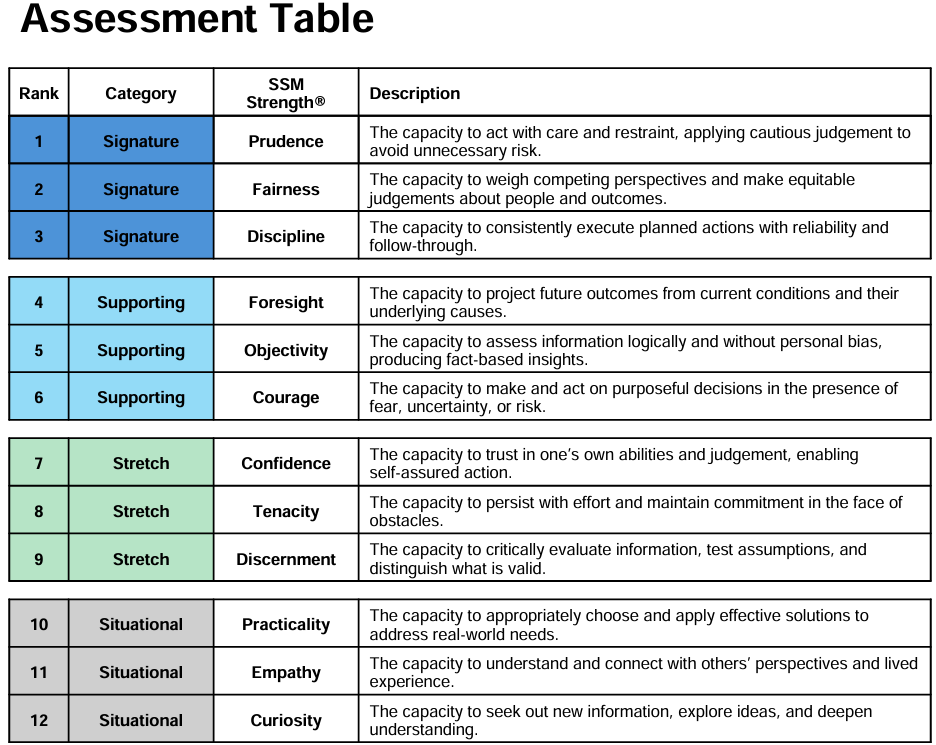
- Produces a clear, individualised ranking of all 12 universal strengths based on algorithm logic.
- Groups your strengths into four tiers: Signature, Supporting, Stretch and Occasional.
- Highlights your core character traits with practical, actionable insights.
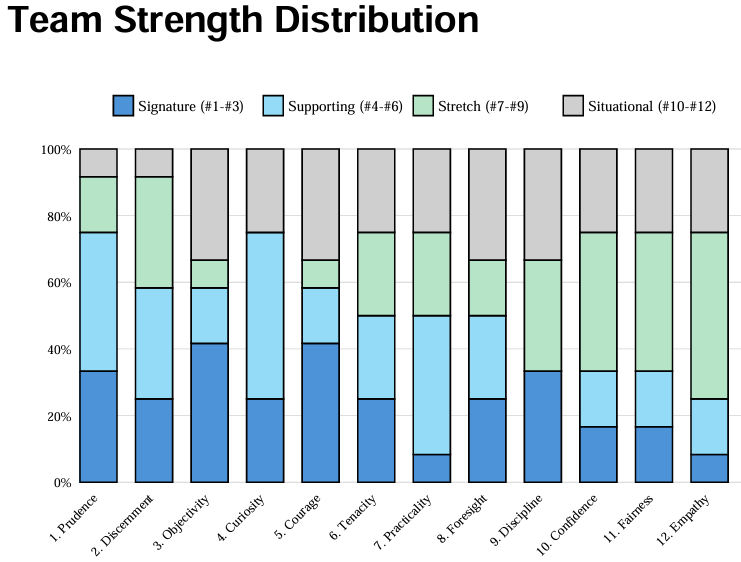
- The strength cluster chart in team reports is also generated using the SSM® ranking algorithm.
5. Maps to O*NET® occupational capability model
From strengths to opportunities
- Connects your strengths to the world of work by mapping SSM® Strengths to O*NET® Occupations, using O*NET® Work Style ratings as a key reference..
- Uses the O*NET® Interest Profiler to identify occupations aligned with your career interests.
- Applies SSM® strengths to occupations showing positive interest alignment, ranking them according to how closely your characteristic strengths align with each occupation.
6. Occupation-fit algorithm
Strengths that fit the role
- Benchmarks an individual's ranked SSM® Strengths against the strengths most relevant to a particular occupation.
- Prioritises the strengths that matter most to the occupation, producing a weighted assessment of strength alignment.
- Delivers a clear, quintile-based rating, showing at a glance the degree of alignment between an individual's strengths and the requirements of the occupation.
Sample Snapshot from an Individual Report
Sample Snapshot from a Team Report